Join or Sign In
Sign in to customize your TV listings
By joining TV Guide, you agree to our Terms of Use and acknowledge the data practices in our Privacy Policy.
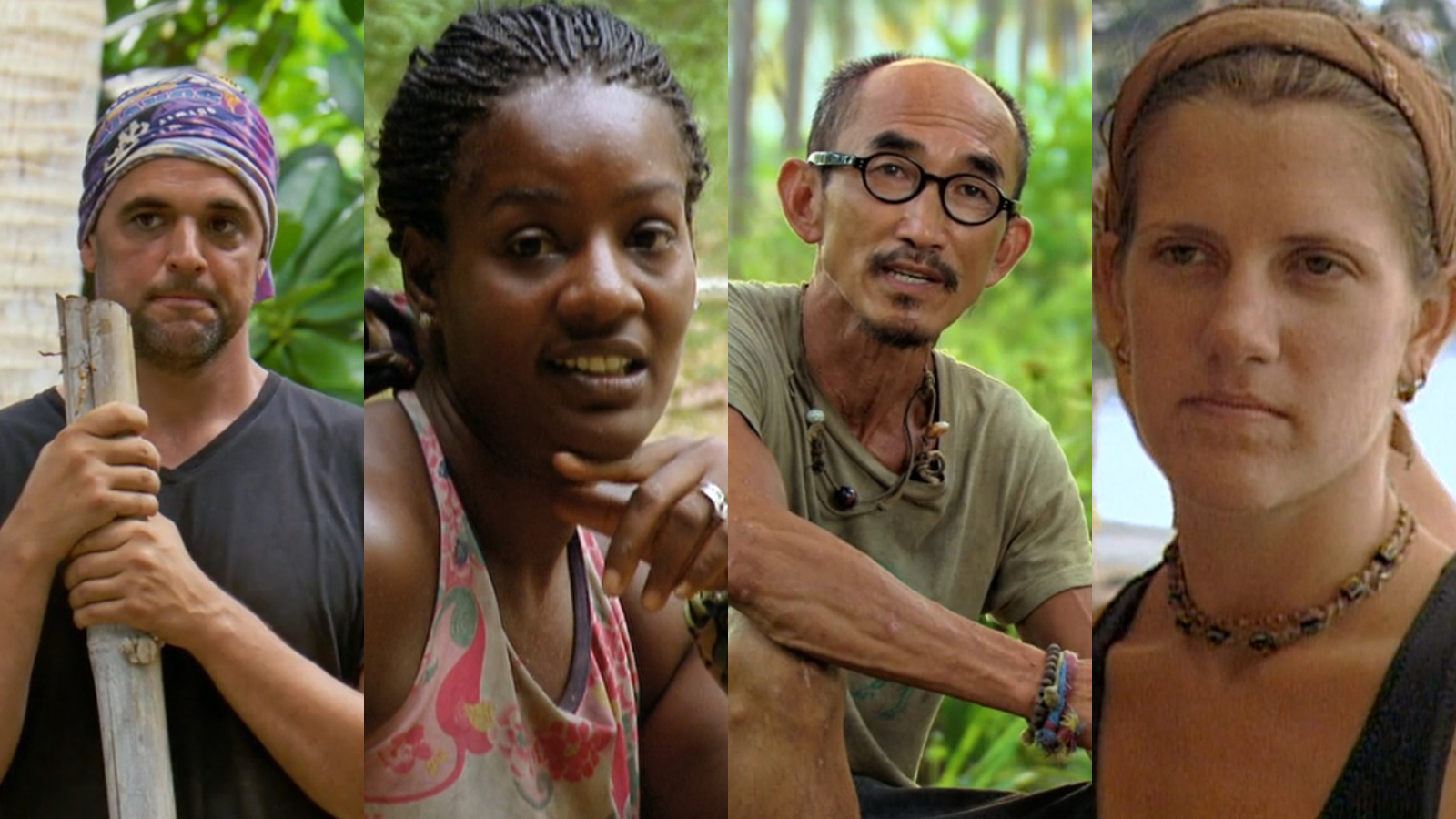
The best Survivor players to never win the game
Only one contestant can win Survivor per season, but that doesn't mean all losers are created equal — or even that all runners-up are created equal. Few can agree on one or even a few specific metrics that make a great player. Which is better: a big, obvious threat who wins challenges and makes big moves but only gets to eighth place, or an under-the-radar floater who gets deemed a "goat" and receives no votes at Final Tribal Council?
In this list of the best Survivor players to never win, we included players from all over the spectrum: plenty of runners-up, but also the contestants who made bold, game-changing moves that could have paid off but ultimately didn't result in a million-dollar check. Sometimes real skill and potential only come out after three or four attempts, and even then, a win is never guaranteed.
Kelly Wiglesworth
It's for the best that Wiglesworth lost the first season of Survivor to Richard Hatch; after all, where would the show have gone if the rat had beaten the snake, if honesty and loyalty were rewarded over smart, cutthroat gameplay? But her challenge wins, along with her place in the first-ever alliance of the game, make her an early icon of the series.
Colby Donaldson
Survivor's first challenge beast was also its first to fit into the traditional "hero" mold, though he comes across as a bit of a blowhard when you watch his original season today. If he hadn't been up against the much-liked Tina Wesson — or if he'd sucked up his pride to apologize for his treatment of on-and-off rival Jerri Manthey — he might've won for his success in the immunity challenges. Instead, he fell one vote short of winning The Australian Outback, and his following two appearances on All-Stars and Heroes vs. Villains led to diminishing returns.
Jerri Manthey
Often considered Survivor's first villainess, Manthey is best remembered for the flirtation-rivalry she and Donaldson shared over the course of three seasons. But while Donaldson's game awareness declined with each repeat appearance, Manthey became more of a player. Many even say she would've won Heroes vs. Villains if she had won that last immunity challenge instead of falling short at four. Imagine that alternate timeline!
Lex van den Berghe
This one is an unusual case because of the controversial trivia-focused final four immunity challenge, during which van den Berghe got dinged for a technically correct answer and didn't face the tiebreaker questions that might have taken him to Final Tribal Council. Many think he would have won if he got there — and he was rewarded the runner-up prize instead of the third-place one as an acknowledgment — although van den Berghe also had his moments of emotional immaturity and impulsivity during both of his times playing.
Kathy Vavrick-O'Brien
The lovably daffy yet badass real estate agent from Marquesas and All-Stars likely would've won her first game if she had made it to the end — and eventual winner Vecepia Towery knew that when she betrayed her, going back on a final-two deal and letting Neleh Dennis win immunity instead.
Rob Cesternino
Like Richard Hatch before him, Cesternino played a huge role in determining the strategy of the game going forward. On The Amazon, he pioneered the technique of flip-flopping between alliances, which almost secured him the win. Unfortunately, his threat level resulted in winner Jenna Morasca cutting him right before the end, and Cesternino subsequently became the first boot of his tribe to go home on All-Stars — but at this point his legacy is cemented, especially thanks to his Rob Has a Podcast podcast empire and an upcoming appearance on The Traitors.
Ami Cusack
In the gender war of Vanuatu, the persuasive and cutthroat power player Cusack had a strong command of the women's alliance. They managed to take out three of the remaining four men around merge before eventual winner Chris Daugherty nosed his way in and overthrew the queen.
Ian Rosenberger
An emotional but savvy player, Rosenberger is most often remembered for his admirable and/or dopey decision to voluntarily step down after a nearly 12-hour final immunity challenge in Palau. Letting Tom Westman take the win ensured Rosenberger's vote out at three, but he might've actually beaten Westman if he had made it to Final Tribal Council.
Stephenie LaGrossa Kendrick
Of course, Palau is also known for the decimation of the Ulong tribe, which went to tribal council eight episodes in a row. The last player standing was Stephenie LaGrossa, a beast in challenges who became an all-time Survivor fan favorite — though she showed a more villainous side in Guatemala, where she got to the end but didn't win.
Rafe Judkins
This underrated player from Guatemala went far using Stephenie LaGrossa as a shield, but played a very balanced physical, social, and strategic game of his own. He's also an early example of the superfan archetype. (These days, you might know him as the showrunner of The Wheel of Time on Prime Video.)
Terry Deitz
Deitz wasn't able to break into the majority alliance when he reached the merge in Panama, but thanks to an awe-inspiring streak of individual immunity wins that got him through to third place, everyone agrees they would've voted him to win at the finals.
Cirie Fields
Fields is widely considered the single best player to never win, and setting aside a surprise pre-merge blindside in Heroes vs. Villains, her record bears that out. In Panama, she got fourth place after going out in final-four fire-making; in Micronesia, a final-two twist forced Parvati Shallow and Amanda Kimmel to vote her out, leading to Shallow's win; in Game Changers, she got eliminated without picking up a single vote in "Advantage-geddon," one of the show's most infamous jump-the-shark moments. Beyond her initial story as a couch potato who "got up off the couch" to play Survivor, Fields is one of the series' greatest characters, a woman whom nobody ever wants to vote out.
Ozzy Lusth
It's unlikely that Lusth will ever win the game; over his four attempts thus far (excluding the upcoming 50th season), he has only slightly tweaked his shaky social game and never attempted to downplay his threat level. But he's an icon of the show regardless, the heartthrob and challenge beast who lost to Yul Kwon by one vote in Cook Islands and played a bold (if a bit arrogant) game in South Pacific.
Yau-Man Chan
In Fiji, Chan was both the smartest player — he's the first to ever correctly play a Hidden Immunity Idol, and the first to ever plant a fake one — and the most lovable. That's why winner Earl Cole had to vote him out before Final Tribal Council, recognizing him as the season's biggest threat.
Courtney Yates
Sure, she's better known for her snarky one-liners than social or strategic prowess, but Yates became a threat in her own right on China. She started off that season as the player who least wanted to be there, but she made it to Final Tribal Council and only lost to Todd Herzog by two votes.
Amanda Kimmel
It's a credit to Kimmel's athleticism, along with her social and strategic skills, that she got to Final Tribal Council two seasons in a row. She was loyal to her core alliance (especially the famous Black Widow Brigade in Micronesia) yet cutthroat when she needed to be, like when she blindsided her boyfriend Ozzy Lusth. But she always got too apologetic at the end, when her refreshingly honest (and villainous) allies Todd Herzog and Parvati Shallow took the prize instead.
Natalie Bolton
Yes, Bolton didn't become a major character until late in Micronesia, and never got another chance to prove her skill at the game. But her presence in the Black Widow Brigade and her key role in executing possibly the greatest move of all time — convincing Erik Reichenbach to relinquish his immunity necklace and then voting him out — more than justify her inclusion on this list.
Stephen Fishbach
If not for Fishbach's poor performance at Final Tribal Council in Tocantins, he might've stood a better chance of putting a crack in the unanimous vote to crown J.T. Thomas Jr. His strategic mind played a big role in getting their tight alliance to the end, but Thomas' likability that season was just too powerful.
Benjamin "Coach" Wade
Despite being one of Survivor's most memorable and unique characters, Coach doesn't get all that much credit for his skill over the course of three seasons. In South Pacific in particular, his control of a tribe of newbies became cult-like, delivering him all the way to the end. If only he could've owned his game instead of sticking to his BS "honor and integrity" mantra at Final Tribal Council.
Tamara "Taj" Johnson-George
Not only was Johnson-George a delightful personality with a great social game on Tocantins, but she formed a cross-tribal alliance with Brendan Synnott at Exile Island, a refreshing new type of partnership.
Russell Hantz
Probably Survivor's biggest villain, Hantz also managed to get to Final Tribal Council twice in a row. Unlike Amanda Kimmel, though, he was able to own his savage gameplay; his bigger problem is his total lack of jury management skills due to being an unpleasant person. Still, Hantz left a huge stamp on Survivor, especially by successfully finding several Hidden Immunity Idols without the help of clues.
Andrea Boehlke
She has never quite managed to stave off attention and reach the end in her three appearances, but Boehlke is one of Survivor's most consistently solid players, making good runs in Redemption Island, Caramoan, and Game Changers thanks to a decent physical, social, and strategic game.
Lisa Whelchel
Whelchel's sweet attitude and complex emotional journey made her arguably the main character of Philippines, where she managed to get to the end after a long struggle with loyalty. She may not be capable of more cutthroat play, and the jury didn't connect with her story like the audience did, but her longevity made her a fan favorite nonetheless.
Malcolm Freberg
Another likable fan favorite from Philippines, Freberg made an even bigger splash as a game player with his double idol play in Caramoan. But his obvious threat level made him an easy target to go, and he went especially early in Game Changers.
Ciera Eastin
She never improved on her first outing in Blood vs. Water, but look, you have to give Eastin credit for doing what no other Survivor player has done: voting out her own mother.
Spencer Bledsoe
Bledsoe fell short of the finals in Cagayan and stood no chance of besting Jeremy Collins at the end of Cambodia. But despite some arrogance and weaknesses when it comes to jury management, he has a great read on strategic dynamics, and he's easy to root for in scrappy underdog mode.
Jaclyn Schultz
Her second-place game in San Juan del Sur pales in comparison to winner Natalie Anderson, but that says more about Anderson (an all-timer) than it does about Schultz, an underrated strategic threat. She came into the season with her boyfriend Jon Misch and managed to weave her way through the game while weathering real bumps in her relationship.
Kelley Wentworth
Wentworth's first appearance alongside her dad in San Juan del Sur went OK, but it wasn't until her return in Cambodia that she became a star. With multiple successful Hidden Immunity Idol plays, including one that nullified a record-breaking nine votes against her, Wentworth's gameplay is undeniable.
Aubry Bracco
Many viewers think Bracco should've won Kaôh Rōng instead of Michele Fitzgerald, whose social game earned her the win. She overcame early neuroses and ultimately became the biggest strategic force of the season.
Tai Trang
Trang is arguably one of the most lovable contestants to ever play Survivor, with a social game that got him to Final Tribal Council in Kaôh Rōng and fourth place in Game Changers. But his messy, occasionally frustrating maneuvering, including multiple flips that created distrust with his allies, sometimes prevents him from getting the respect he deserves.
Cydney Gillon
Possibly one of the one-time contestants most deserving of a second chance, Gillon played a remarkably well-rounded game in Kaôh Rōng, combining brains and brawn.
David Wright
Like Aubry Bracco before him, David Wright struggled with paranoia and anxiety early on but grew into a surprise strategic powerhouse, eventually making him the biggest threat to win in Millennials vs. Gen X until he was taken out at four.
Zeke Smith
Smith most often comes up these days because of the infamous tribal council in Game Changers when Jeff Varner (and thus the show itself) outed him as transgender, a low point in Survivor history. But he also played a commanding, charismatic game during his first appearance in Millennials vs. Gen X.
Chrissy Hofbeck
Hofbeck's social game didn't get the jury's respect when she went up against Ben Driebergen in Heroes vs. Healers vs. Hustlers, but her strategic sense was impressive, along with her record of four individual immunity challenge wins.
Domenick Abbate
It's hard to argue that Abbate made a mistake by going all the way to the end with his No. 1 ally, Wendell Holland, with whom he dominated the game in Ghost Island. Unlike many a losing finalist, he was far from a goat; he had basically just as much control over the votes as Holland or more, and the vote at Final Tribal Council resulted in a historic tie until second runner-up Laurel Johnson crowned Holland. In many ways, this is the closest near-win of all time.
Mike White
Arguably the rightful winner of David vs. Goliath, Mike White (yes, the Mike White) played an understated but strong game sustained by solid social bonds and strategic awareness. His prior fame was barely a factor!
Christian Hubicki
One of the biggest social and strategic threats of the last 20 seasons, the nerdy charm of robotic scientist Christian Hubicki made him a surprising force to be reckoned with on David vs. Goliath.
Janet Carbin
It's too bad the Dan Spilo sexual harassment incident soiled the reputation of Island of the Idols, because there are several smart players deserving of another shot, especially Carbin. One of the strongest older female contestants on the show, she had an impressive level of focus, game sense, and adaptability that almost got her to the end — if not for the idol nullifier that Dean Kowalski won with a damn coin flip.
Kellee Kim
Yes, she went out with two idols in her pocket, but Kim also faced some unusual circumstances in Island of the Idols: her own experience of sexual harassment was used as a smokescreen to blindside her. It's worth acknowledging her skill at the game, though, when it comes to both finding idols and social maneuvering. And sneaking Dean Kowalski an idol to discreetly eliminate Jack Nichting was a great move on its own terms, no matter the end result.
Ricard Foyé
Foyé and his ally Shan Smith were the strategic powerhouse of the Ua tribe in the pre-merge, and after he turned on her (possibly prematurely), Foyé was left as the biggest threat of the season, falling short at final five.
Shan Smith
Smith is the first and still one of the most entertaining antiheroes of the New Era, a "mafia pastor" who set aside her morals to rule the season with Foyé. Production also scored a tune to accompany the evil theme she sang while plotting her machinations, emphasizing her central role on Season 41.
Omar Zaheer
The friendly puppet master of Season 42 managed to control much of the game from the shadows, only falling at the hands of winner Maryanne Oketch after Drea Wheeler exposed his sneaky game and inflated his threat level.
Jesse Lopez
Lopez ran circles around his fellow cast members on Season 43, which featured some of the weaker gameplay of the New Era. He operated from behind the scenes while hiding behind his ally and shield Cody Assenmacher, then cut him shortly before the end. Unfortunately, he fell short at fire-making, or he would've been an easy vote to win from almost everyone on the jury.
Carolyn Wiger
The underdog Tika 3 alliance made Season 44 a highlight of the New Era, and Wiger was a key part of that. Her strong bullshit detector and emotional yet cunning gameplay made her a strong contender, which makes it all the more unfortunate that she picked up zero votes at Final Tribal Council. At least her time on The Traitors cemented her star status.
Carson Garrett
Your mileage may vary when it comes to the young superfan from Season 44, but you have to hand it to him for his strategy of 3D-printing replica Survivor puzzles to practice at home. You can't argue with the results, or with his key role in keeping the Tika 3 together.
Emily Flippen
After her occasionally abrasive personality rubbed castmates the wrong way in the premiere of Season 45, Flippen underwent one of the fastest growth arcs ever, settling into the tribe and making social connections with the help of Kaleb Gebrewold. She likely stayed tight with the Reba Four alliance too long, but it's especially impressive that she made it so far with such a rough beginning.
Charlie Davis
Many still believe Davis' strategic acumen and control of information should've netted him the win for Season 46. But Kenzie Petty's strong relationships and personal story won out in the end — a result clinched by Maria Shrime Gonzalez in a memorable betrayal of Davis, her onetime ally.
Genevieve Mushaluk
Mushaluk's hesitance to make strong emotional connections made her a compelling character in Season 47, enabling her to make several brutal cuts like Kishan Patel and Sol Yi but making her a big target late in the merge.
Joe Hunter
The second runner-up from Survivor 48 played a physically and socially dominant game, to the point that he and his No. 1 ally, Eva Erickson, seemed to control almost every vote post-merge. It's a little shocking that Hunter only got one vote to win at Final Tribal Council, but Kyle Fraser successfully argued that he had a greater awareness of the game by playing the middle.
Kamilla Karthigesu
Through some good acting and a secret alliance with Fraser, Karthigesu successfully played the middle and bottom for most of Survivor 48, outlasting most of the cast and manipulating Joe Hunter into voting out his ally Shauhin Davari.
ALSO READ: The biggest Survivor 50 cast snubs